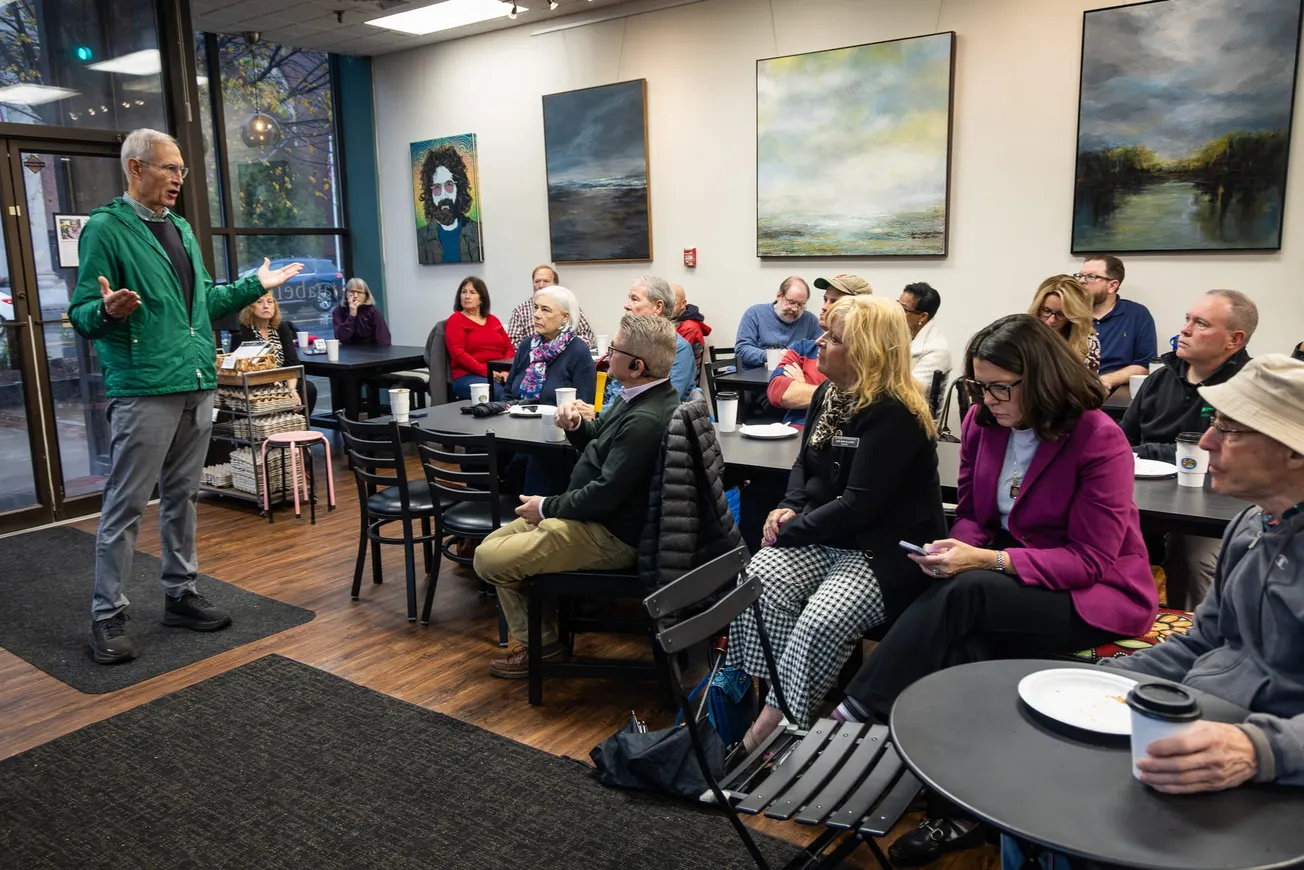

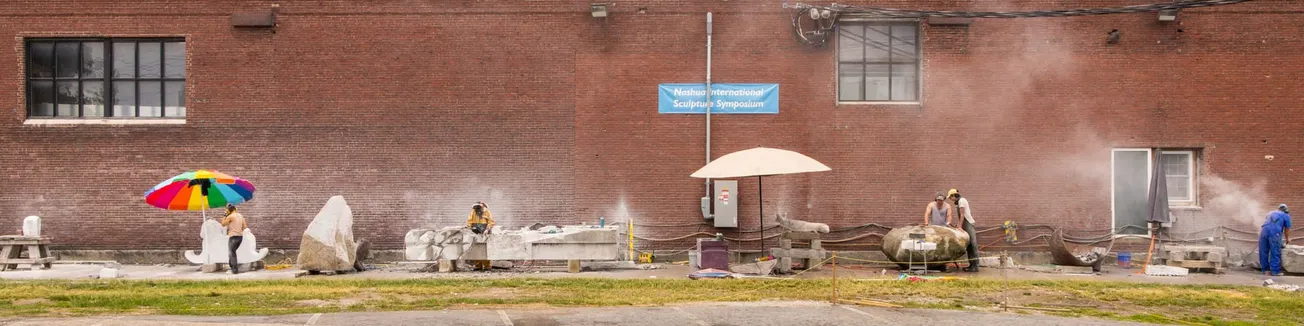
The Nashua International Sculpture Symposium completed its second week, and the four artists are making real progress on their creations. The Nashua Independent had a chance to sit down with busy Creative director of the Symposium Jim Larson to learn about the origins of the stones and the aesthetics of each type.
The collection of massive stones at this year’s Nashua International Sculpture Symposium (NISS) carry stories that stretch from 19th‑century Maine quarries and Boston building demolition sites to a Nashua schoolyard and a Vermont marble shed. Each of the four artists’ works with distinct material, chosen as much for its history and internal structure as for its visual impact.
Deer Island granite: a “third life” in Nashua
One of the most compelling materials on site is a pair of massive Deer Island granite blocks, salvaged from a Boston building torn down in the 1980s. Larson explains that the blocks have already lived several lives.
“A sculptor named Joseph Wheelwright, who passed away a few years back, was going by when the building was being torn down, and he managed to snag the two pieces,” Larson said, recalling how the stone left its architectural role and ended up outside Wheelwright’s Boston studio. “And he had them outside of his studio in Boston, which he shared with Nora Valdez for a while.”
Many years later, when that studio needed renovation, the stone moved again. “Nora was like, we can’t even move these stones, Jim. Like, if you can help us out, you can have the stones,” Larson said. After some work in exchange, the granite came to Nashua, where he now thinks of it as entering a rare “third life”: one in nature, one as part of a building, and now as a public artwork.
Larson reads the stone’s age in its tooling. Asked when he thought it was quarried, he said, “Yeah, probably 1880s… Judging by the marks on it, 1880s.” The blocks likely came from one of only two coastal Maine quarries known for producing exceptionally long, unfractured horizontal architectural pieces. The original element, he noted, “was one lentil… and that’s what that quarry is known for, because it has these really, really long horizontal beds with no fractures running vertically.”
Today, those long beds survive as two monolithic pieces, about 10,000 pounds each. That size and scale, and the marks from earlier craftsmen, give this year’s sculptors a chance to respond to a century of material history already written into the surface.
Jonesboro Red granite: a working quarry’s voice
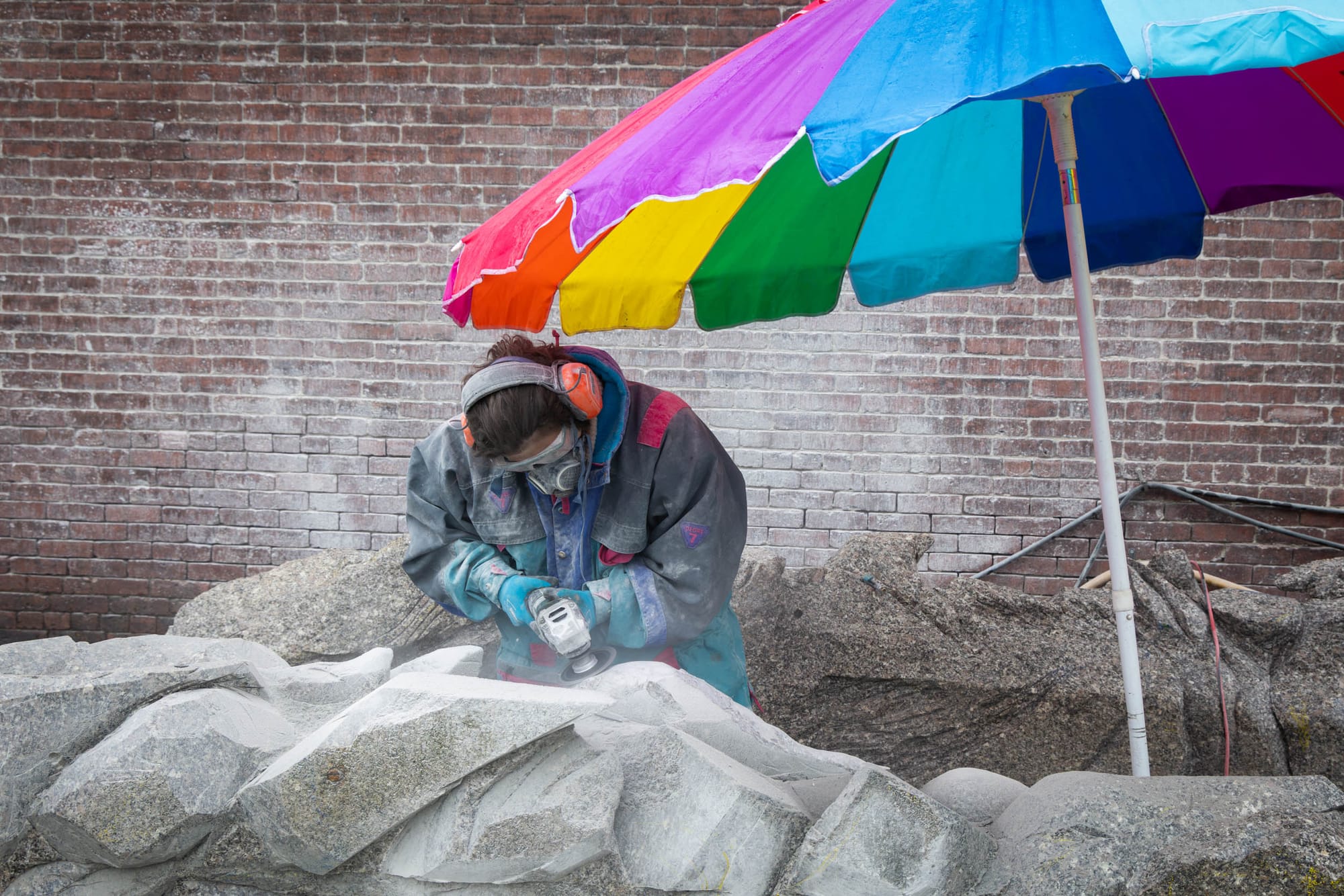
In contrast to the recycled Deer Island blocks, another artist is working with fresh stone from an active source. “The granite that Sean is carving is a piece of Jonesboro Red, which is from Jonesboro, Maine, an active quarry near MDI (Mount Desert Island, ME),” Larson said.
Sean Williams, a second‑generation granite carver from Barre, Vermont, brings deep history of stone shop culture to the Symposium. Barre, Larson noted, “is very much the Carrara of the granite world,” a place where granite is a way of life. That matters because another sculptor on site, Anna Multone, is from Carrara, Italy itself. “And Anna is from Carrara… so we have two career stone carvers that are both very young, they live in these two hubs of working these materials, and to see them like working side by side is so, so interesting,” he said.
Jonesboro Red is hard, durable, and warm‑toned, encouraging bold, structural forms that emphasize permanence. In a field where according to Larson, one tradition questions why anyone would carve “something so soft and impermanent as marble” and the other wonders why someone would tackle “inelegant” granite, the Jonesboro block is a focal point for comparing materials, technique, and cultural expectations.
A Nashua boulder: local ground, local story
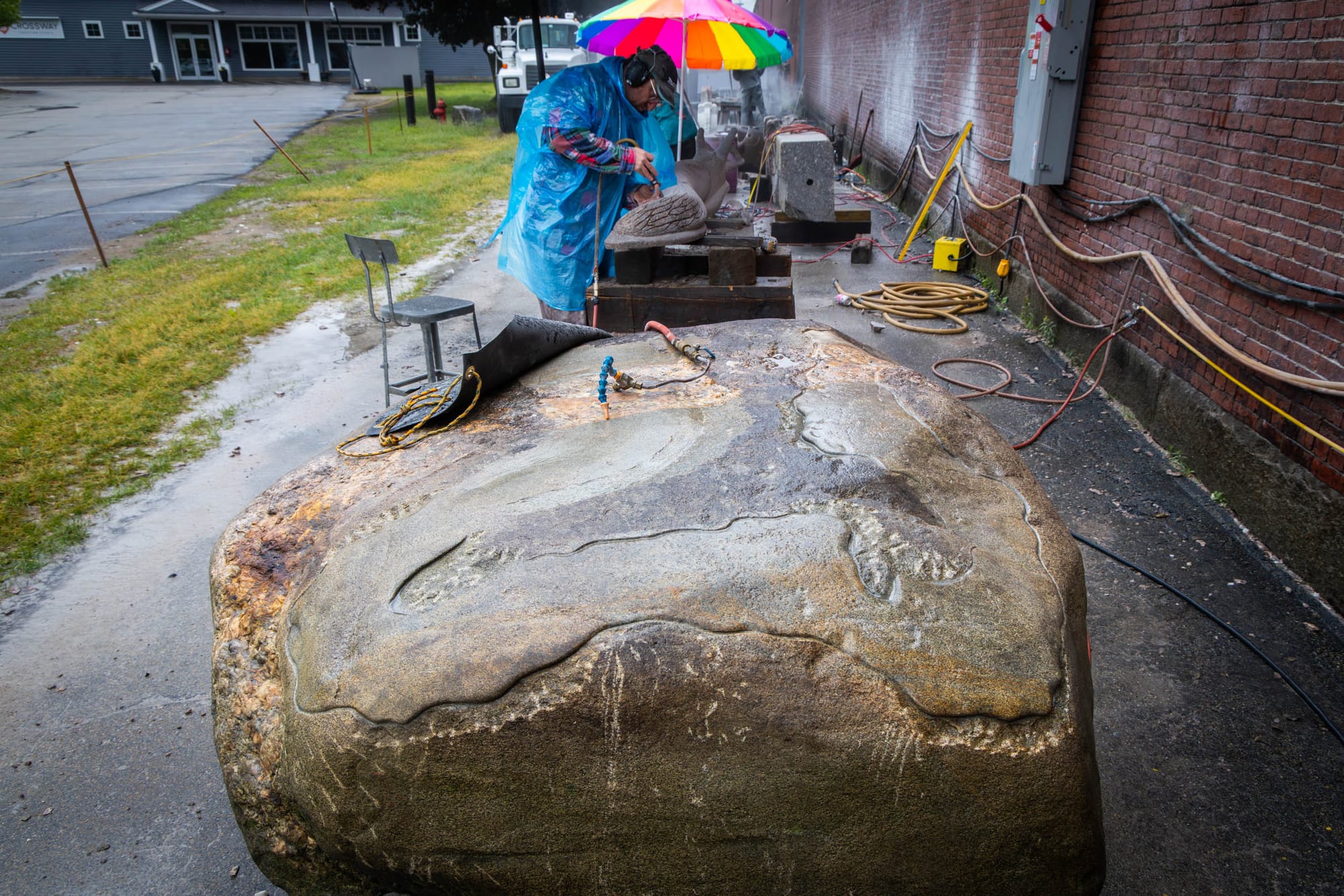
Not all the stone this year arrives on trucks from distant quarries. Larson and the team also sourced a granite boulder from within the city itself.
“On the back of the truck this morning, we just picked up this boulder that came from near Nashua South,” he said. Because it’s being relocated, not removed from the city’s inventory, officials allowed the Symposium to use it as support for a new sculpture. “The city said, because we’re not taking it from the city, like we’re just using it to put somewhere else in the city, that we can use it to install a sculpture.”
The boulder is “a giant granite boulder with a nice vein running through it,” Larson added. Its glacially rounded shape and strong vein offer natural features for the artists to emphasize, rooting an international event in a tangible piece of Nashua’s own geology.
Champlain Black limestone: fossils, seams, and a “sandwich”
If the granites speak of mass and durability, the Symposium’s Champlain Black limestone introduces a layered, almost fossil‑like counterpoint. “We have this big block of black limestone… that had this seam running right through the center of it,” Larson said.
As a sedimentary rock, the stone reveals its structure in stacked bedding planes. “Sedimentary stone, so it has bedding, like the sediment stacks up. And along that bedding plane, sometimes it has weaknesses, and that’s where the seam was,” he explained.
Normally, that weakness might disqualify a block for outdoor sculpture. But this year, it became a feature, not a flaw, thanks to sculptor Paulina Bergers’ concept. “Paulina gave me the dimensions that she needed and told me what she was going to be doing with the piece, making this kind of sandwich‑style sculpture,” Larson said. “If not for having told me what she was going to do with it, I wouldn’t have known that that was an acceptable piece of stone with the seam in it.”
Larson sourced the limestone from “the family that owns the Champlain Black Quarry in Isle La Motte,” the same quarry that supplied the stone for last year’s sculpture “Cary.” The block on site contains visible fossils and a dramatic split between two layers, making Paulina’s layered “sandwich” a literal expression of geological time.
Vermont white marble: learning to carve light
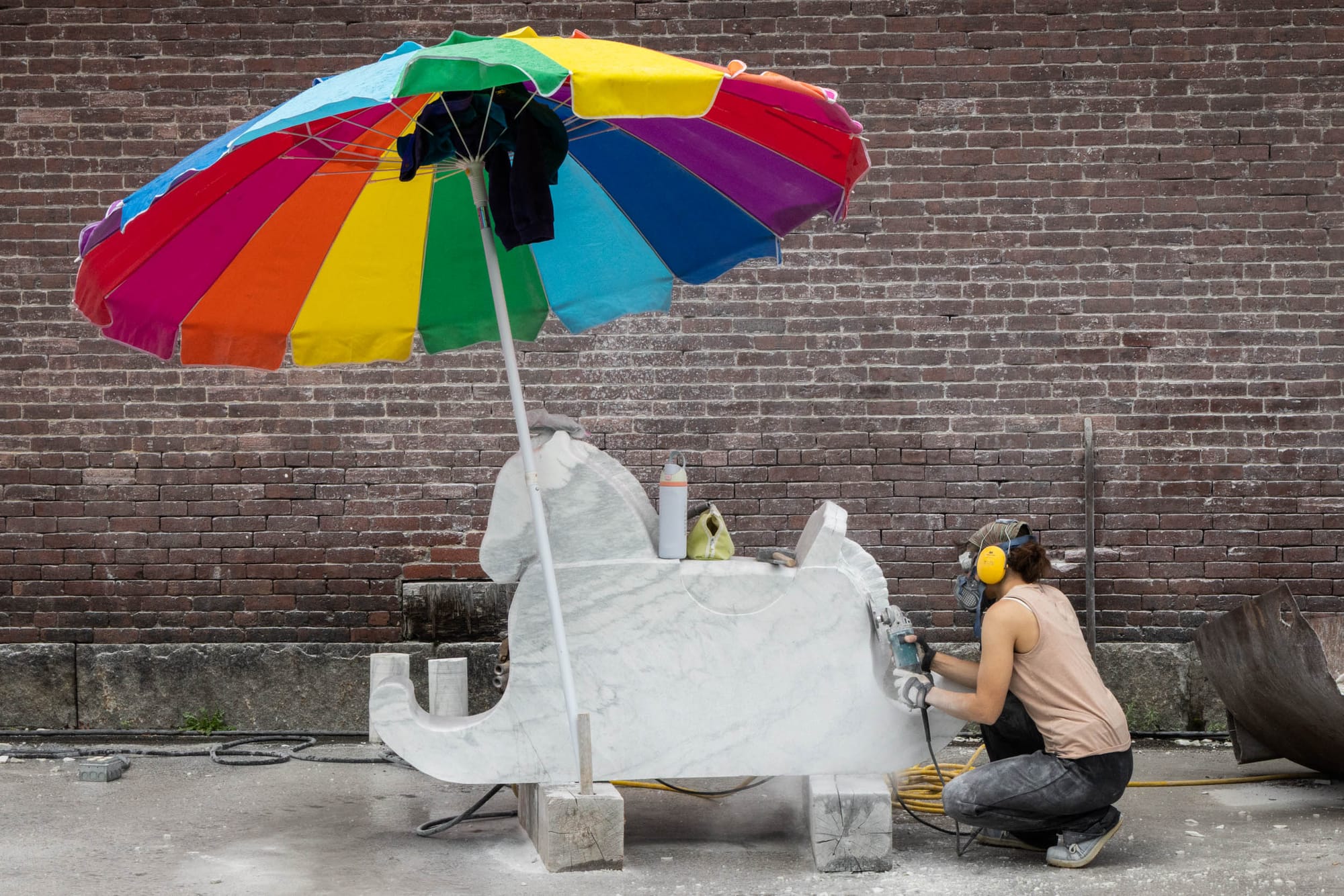
Balancing the dark limestone and rugged granites is a fourth stone: white marble from Vermont, which Larson says the marble here is not just a different rock; it is almost a different language.
“There are a lot of differences between the materials,” he said. One of the most important is how they interact with light. “One that might not be quite so obvious but starts to be once you really think about it, being a material that holds or doesn’t hold light, marble is very translucent. And it lights up when light hits it.”
That translucency forces marble carvers to exaggerate shadows. “So you need to carve really deep and exaggerated shadows… to be able to tell your story, to have something look as it would,” Larson explained. You are not carving exact anatomy; you are carving how forms look under light. “You’re not carving how its volume actually is, you’re carving how it looks. And it’s a totally different thing to have the shadow of stone look lifelike.”
In the Symposium yard, Anna from Carrara and Sean from Barre work side by side, each steeped in their local stone culture and each encountering the other’s “language” of granite or marble in real time. That proximity, Larson said, is the point.
“The number of organic conversations they have throughout the day, you cannot count,” he said. “Most of the time, they’re asking, why are you doing what you’re doing? And why do you do it that way? It’s the point of a symposium, is to come together to talk.”
In Nashua this year, the stones themselves are the starting point for conversation, reminding visitors that every sculpture begins long before the first hammer hits the first chisel.