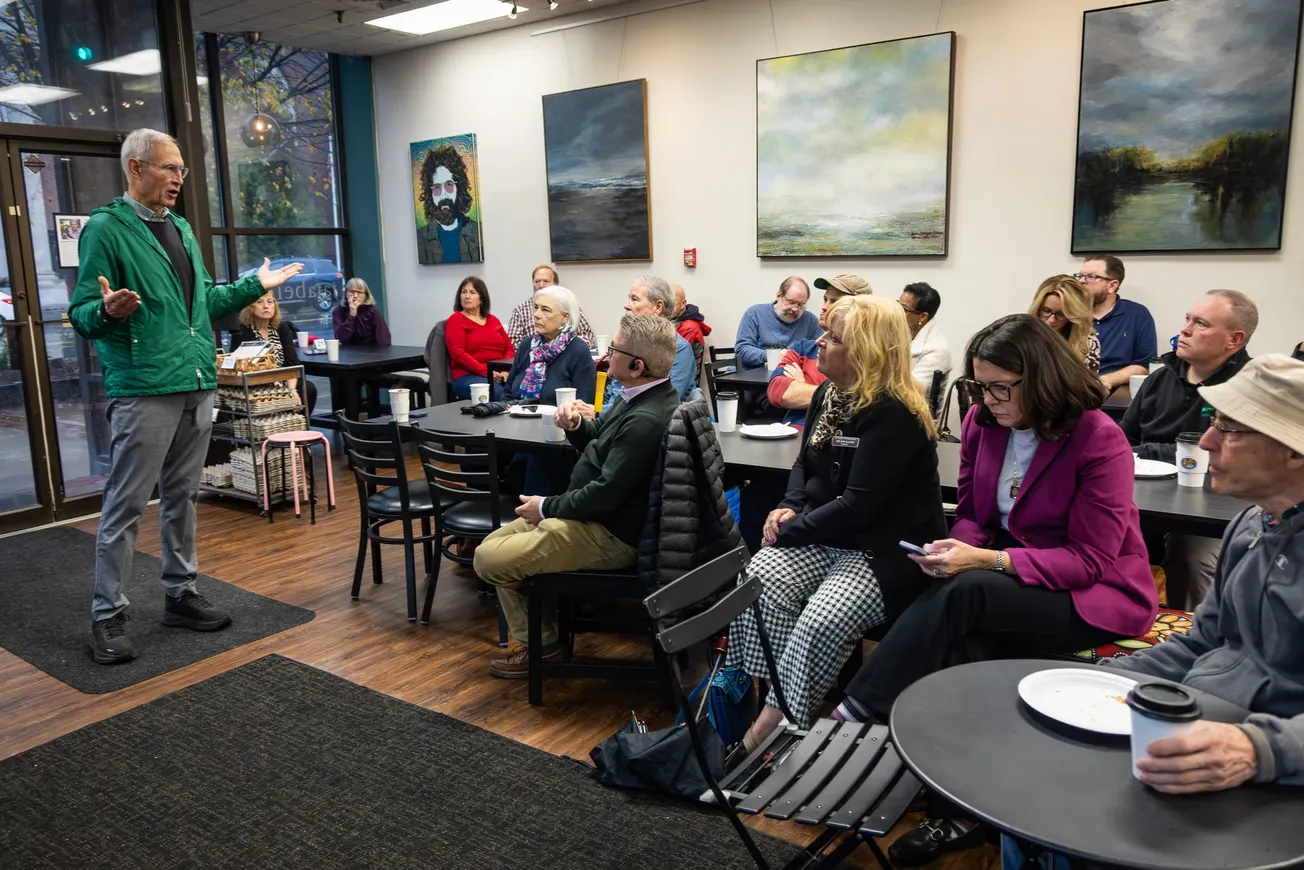


Laura Telerski grew up in the same Nashua neighborhood where she lives now. That's not an accident.
Her parents, moved to Nashua's south end when her father landed a job at Harris Corporation in the 1970s. She enrolled as a fourth grader at Bicentennial School, went on to Fairgrounds Middle School, graduated from Nashua High School, left for college and graduate school — Georgetown, then the University of Chicago — and eventually came back to the same neighborhood she'd grown up in, just a few houses down from her childhood home. She and her husband Jason have been there nearly 24 years.
"When we thought about where we wanted to raise our kids," she said, "there was no place better than Nashua." That connection to Nashua is intentional. It is the connective tissue of Telerski's political life.
Currently she is serving Ward 8 in the New Hampshire House of Representatives. On April 9 she announced that she is running for the state Senate seat being vacated by retiring Sen. Cindy Rosenwald. Her candidacy for the district 13 seat is an extension of her career translating the concerns of a Nashua neighborhood into state policy.
The District Between the Exits
Ward 8 includes a stretch of Nashua's south end roughly between Exit 1 and Exit 4 on the Everett Turnpike. She describes the ward with the clarity of someone who has knocked on nearly every door: Royal Crest and Bluestone apartment complexes along the DW Highway and Spitbrook Road corridor, the old Lancashire Heights neighborhood, single-family homes lining East Dunstable Road on both sides, and the Bicentennial School neighborhood anchoring the whole geography.
She describes the ward as a genuine mix of people, roughly a quarter to a third of her constituents rent apartments or condos; the rest own their homes. It's a working- and middle-class district, exactly the kind of place where a $70-a-month co-pay on Medicaid or a few thousand dollars diverted from the local school budget lands differently than it might on a spreadsheet in Concord.
The Work Behind the Scenes
She has served four terms in the State House. Telerski is candid about what surprised her when she arrived at the State House. The public face of legislating, the floor speeches, the votes, turns out to be only a fraction of the job.
"I had no idea what the actual work was once you were in there," she said. "So much of our work happens in the committee room."
Getting a bill over the finish line means shepherding it through public hearings, building coalitions with advocates, navigating amendments, securing a committee vote, passing the full House — and then discovering it's a "second committee" bill and having to do it all again before it even reaches the Senate. It's slow, sometimes frustrating work, and Telerski has made her peace with that.
"It's a good thing that it's hard to change," she said. "You don't want to do things at the last minute. You want things to be properly vetted. You want the community to have a say."
An important part of the job, she says, is constituent services. The calls from residents who've hit a bureaucratic wall and don't know where to turn. "I want to be that approachable person," she said. "When they say, 'I don't understand how to do this, can you help me?’ That’s what I'm here for."
The Jenga Tower
Telerski becomes particularly animated when she begins to talks about healthcare policy. She serves as the ranking Democrat on House Finance Division III which is the budget panel that oversees the Department of Health and Human Services.
She has spent her tenure in the House, watching what happens when the state chips away at Medicaid coverage. What she describes is a cascade.
"It's almost like a Jenga tower," she said. "You touch one of those bricks that involve Medicaid, and all of a sudden the whole tower in the state falls down."
She describes the consequences of these changes in the New Hampshire's budget, signed into law by Gov. Kelly Ayotte, which imposes co-pays on Medicaid recipients.
“We're talking about people earning around $17,000 a year, now expected to set aside roughly $70 a month to keep their coverage. Most can't. They drop off.”
“Without insurance, they skip the preventive care — the annual checkups, the screenings — that most of us take for granted. When they do get sick, they show up at emergency rooms with advanced illness. Hospitals treat them but can't collect. Uncompensated care spikes. Under that financial pressure, fewer physicians are willing to practice in New Hampshire. Rural clinics struggle and close. The whole system gets sicker.”
"In the end, all of us are going to pay that bill," Telerski said. "You're going to have fewer providers. You're going to have rural medical centers closing. It really is a snowball."
She has sponsored legislation to repeal the Medicaid premiums, which she says will generate a projected $25 million on paper; but only by forcing the state's poorest residents off the program entirely.
"They Blew the Top Off of It"
Public education is another front on her agenda. Telerski has been a loud critic of New Hampshire's Education Freedom Account program, the state's school voucher system; and her frustration isn't primarily ideological. It's mathematical.
The program started as a modest school-choice option for low-income families, offering state funds — $4,000 to $7,000 per child, depending on circumstances — that could be used for private school tuition or homeschooling. In the most recent state budget, Republicans removed the income cap entirely.
"They blew the top off of it," Telerski said. "Now millionaires who already sent their kids to private schools are just getting thousands of dollars in subsidy."
The program's funds can also now be used for extracurricular activities; ski lift tickets, swim lessons, horseback riding as physical education credits.
The data, she says, makes the rationale for the program collapse. Close to 85 to 90 percent of participating children were already in private schools or already homeschooled. The program isn't rescuing kids from failing schools; it's redirecting tens of millions of dollars out of the Education Trust Fund that would otherwise go to neighborhood public schools. New Hampshire, she notes, already ranks last in the country — 50th out of 50 — in state funding for public education.
"We need to support our neighborhood schools in a way that provides opportunity for all kids," she said.
The Free State Factor
A force in New Hampshire politics that Telerski believes most New Hampshire residents don't fully see is the Free State Project
“It's a libertarian movement, a few decades old, that targeted New Hampshire as a place to relocate, run for office, and systematically shrink government. Over the past eight years”, Telerski says, “its influence in the Republican caucus — and among "Free Stater-adjacent" members who share the agenda if not the formal affiliation — has grown significantly.”
"It's all about the slow dismantling of government," she said, "making it smaller and smaller until it potentially doesn't exist anymore."
She points to the elimination of vehicle safety inspections as a recent example — a last-minute concession tucked into the state budget because Republican leadership didn't have the votes to pass it otherwise. The pattern, she argues, also shows up in curriculum restrictions, erosion of public health norms, and the ongoing defunding of public schools through the voucher program.
A Bigger Stage
When Sen. Cindy Rosenwald announced her retirement, Telerski says the decision to run for the seat wasn't something she had mapped out in advance. But the connection between the two women's work made the path feel natural to her.
Rosenwald had personally advocated for Telerski to join the House Finance Committee, pointing out that no one from Nashua had served on it since Rosenwald herself left the House. The mentorship has been real.
"She works her butt off," Telerski said of Rosenwald. "You maybe don't have a bill signed into law with your name on it, but she has touched more lives through her work on the state budget over the years than probably anyone else. And she's always advocated for people in Nashua first."
Telerski hopes to carry the lessons learned in the House Finance Committee into the Senate, to fight for what she calls "the kitchen table things”, healthcare access, school funding, housing affordability; from a seat with more leverage.
"I feel that the impact of the state budget on communities is so important," she said. "You can influence all aspects of the state and how it touches Nashua."
She'll be on the November ballot, running to represent the same south Nashua neighborhoods she grew up in, came back to, and has spent four terms fighting for, just from a different seat.